
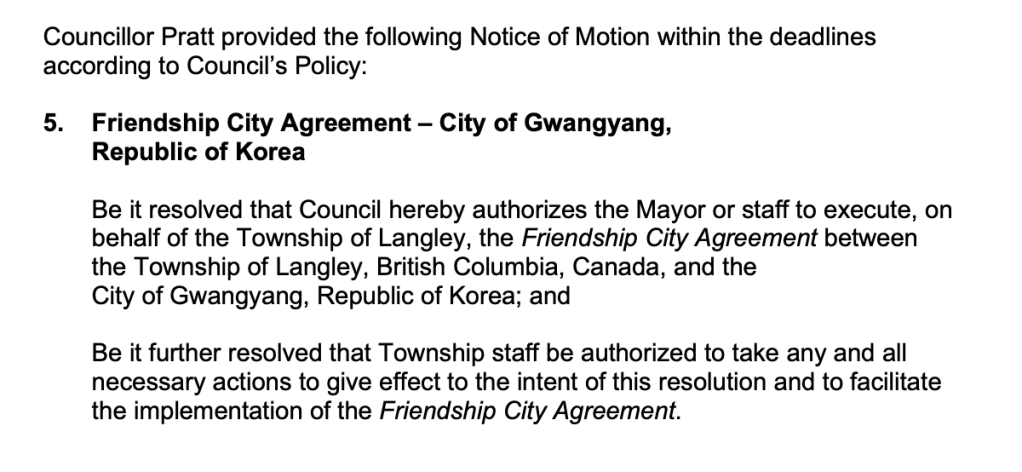
On November 3, 2025 the Township of Langley Council approved a resolution authorizing the Mayor or staff to execute the Friendship City Agreement with Gwangyang in the Republic of Korea (South Korea). The agreement itself is relatively brief and general. It commits the two municipalities to promote exchange and cooperation across broad areas including education, tourism, economy, culture and the arts, it remains in effect unless either party gives notice to terminate.
The most substantive argument raised by Councillor Richter was not about the concept of a friendship relationship. It was about whether the Township had done the basic preparation to approve it. Councillor Kim Richter opposed the motion, arguing that Council was being asked to sign off without a clear policy, oversight, or costing framework. This is not merely an approval of the concept of a friendship relationship. The resolution has some financial, resource, and staff time implications as it authorizes Township staff to take any and all necessary actions to give effect to the intent of the resolution and facilitate implementation of the agreement. That’s a very open-ended cheque to write. The resolution allows for the details of the relationship to be developed later through staff work, Council direction, and community programming.
Richter’s critique was not against the concept of friendship. She acknowledged that partnerships can be valuable and that a relationship with a Korean city makes sense in Langley’s context. Her objection was to the lack of procedural clarity: Council was being asked to approve the agreement without the Township having done the basic administrative groundwork that normally makes such approvals accountable. Her questions were framed as straightforward governance questions:
Who drafted the agreement in front of Council?
Was there any external framework or oversight involved, such as the Federation of Canadian Municipalities or UBCM?
Does the Township have a policy or procedure that governs friendship or sister-city arrangements?
What are the expected costs or operational commitments, even at a high level?
The answers she received from Township staff indicated that the document was provided by the other party, there is no external oversight body involved, and that the Township currently has no policy in place for these agreements. Council was asked to approve a relationship document that is open-ended in scope. In the discussion, staff indicated that the Township does not currently have a formal policy defining how these agreements are initiated and vetted, what minimum costing or resourcing analysis should accompany them, or what oversight or reporting is expected after approval.
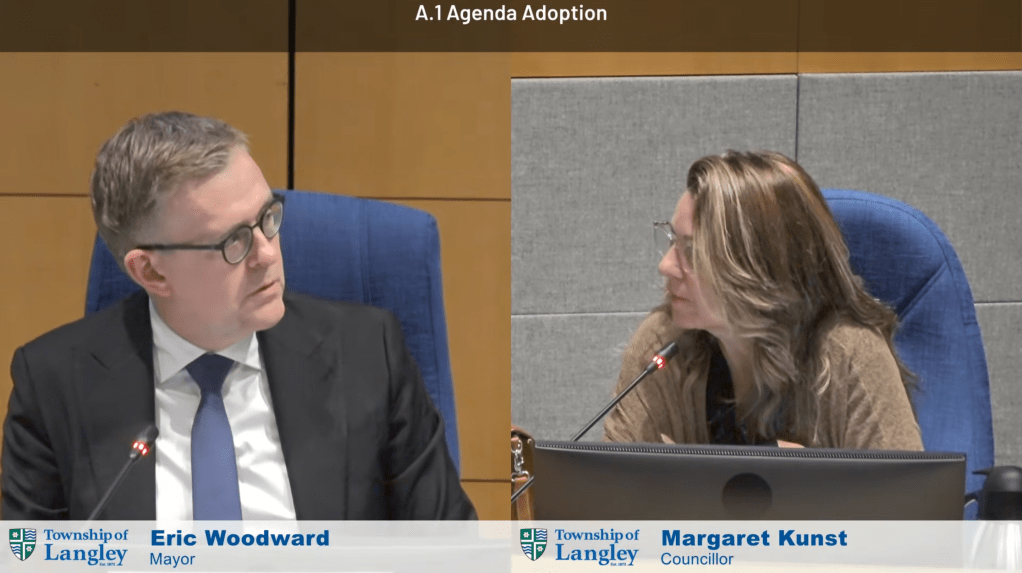
Councillor Richter concluded that approving the friendship agreement first and deciding the Township-side parameters later is backwards. In her words, Council was “putting the cart before the horse.” That’s why she voted against the motion. Mayor Woodward pushed back, saying Council was not going to “create a large process” for something that “maybe happens once,” and adding that when there is “a good thing happening,” critics “usually raise the process.”
From a governance perspective, municipalities do not only govern the controversial items. They also govern the pleasant ones. Policy is how you keep decision-making standards consistent. The Township now has a Friendship City Agreement approved, and Council has authorized staff to proceed.
Richter’s dissent raised process concerns, noting that Council was being asked to approve an open-ended agreement without, in her view, clear Township-side answers to questions about authorship, oversight, policy, and costs. Richter called it “putting the cart before the horse”. From a broader perspective, the Township’s ballooning debt underscores the stakes. Approving unknowns first is how “nice” decisions become expensive ones.



 The Langley Monitor
Leave a comment